
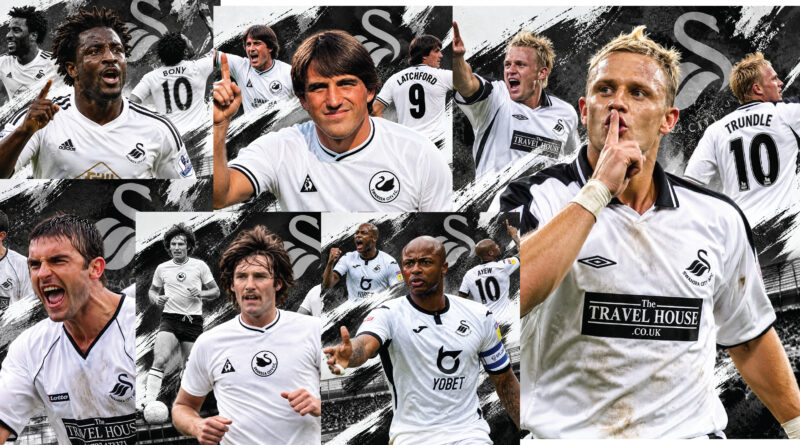
Our Greatest Ever Striker
The results are in from our search for Swansea City’s greatest attacking wide men, and it turned into a remarkably close contest between the club’s finest.
Alan Curtis topped the poll, narrowly ahead of Leighton James, with the pair taking their places on opposite flanks in our Greatest Ever XI. Cliff Jones finished third, while Nathan Dyer and Wayne Routledge also attracted plenty of support.
With our wingers decided, we now move on to the final attacking position. From the remarkable rise under John Toshack to the Premier League years, Swansea have been blessed with some outstanding forwards. We’ve narrowed the selection down to six, but only one can make our team.
So, who is Swansea City’s greatest ever striker?
Wilfried Bony
When Swansea paid a club-record £12 million to sign Wilfried Bony from Vitesse Arnhem in July 2013, expectations were understandably high. The Ivorian had been the leading scorer in the Dutch Eredivisie, but few could have anticipated quite how quickly he would establish himself in the Premier League.
Bony was a formidable centre-forward, combining tremendous physical strength with an excellent first touch and a natural instinct for goal. He could hold off defenders, bring teammates into play and finish with either foot or his head.
He scored 25 goals in all competitions during his debut season, including memorable strikes against Manchester United in the FA Cup and Valencia in the Europa League. In 2014, he scored 20 Premier League goals, more than any other player in the division during that calendar year.
His performances eventually earned him a move to Manchester City in January 2015. Bony returned to Swansea in 2017, although injuries prevented him from reproducing the form of his first spell. At his peak, however, he was one of the most effective centre-forwards in English football.
Lee Trundle
Few players have captured the imagination of Swansea supporters quite like Lee Trundle. Arriving from Wrexham in July 2003, he joined a club that had narrowly avoided relegation from the Football League just two months earlier. What followed was four years of goals, outrageous skill and entertainment.
Trundle scored on his debut against Bury and followed it with a hat-trick against Cheltenham Town. His ability to produce something unexpected quickly made him a favourite at the Vetch Field, while his tricks and spectacular finishes regularly featured on Soccer AM.
But Trundle was much more than a showman. His goals were instrumental in Swansea’s promotion from League Two in 2004–05, and he continued scoring as the club established itself in League One. He also produced one of his most memorable moments with a superb volley against Carlisle United in the 2006 Football League Trophy final, helping Swansea lift the trophy at the Millennium Stadium.
He left for Bristol City in 2007 before returning on loan in 2009. Although his greatest years came outside the topflight, his contribution to Swansea’s revival was enormous. For supporters who watched the club rebuild from the bottom of the Football League, Trundle remains one of the defining figures of that journey.
James Thomas
There are players who become legends through years of consistent performances, and others whose place in a club’s history is secured by one extraordinary afternoon. For James Thomas, that afternoon came on 3 May 2003.
The Swansea-born striker joined his hometown club from Blackburn Rovers in the summer of 2002, at a time when the Swans were struggling both on and off the pitch. By the final day of the season, their Football League status was hanging in the balance.
Swansea needed victory against Hull City at the Vetch Field to guarantee survival. Thomas opened the scoring with a penalty, but Hull fought back to lead 2-1. He equalised shortly before half-time and then completed his hat-trick with another penalty in the second half. Lenny Johnrose added the fourth as Swansea secured a dramatic 4-2 victory.
It was a performance that helped preserve the club’s Football League status and, with hindsight, played a crucial part in making everything that followed possible.
Thomas scored 16 goals in 57 league appearances for Swansea, but a recurring knee injury brought his playing career to a premature end. His career may have been relatively short, but few players can claim to have delivered three more important goals in a Swansea shirt.
André Ayew
André Ayew arrived at Swansea from Marseille on a free transfer in the summer of 2015, bringing Champions League experience and an established international reputation with Ghana. He made an immediate impression, scoring against Chelsea on his Premier League debut and collecting the division’s Player of the Month award for August.
His performances earned him a £20.5 million move to West Ham United the following summer, but he returned to Swansea in January 2018. Although the club suffered relegation at the end of that season, Ayew would eventually become a central figure in their attempts to return to the Premier League.
After spending 2018–19 on loan at Fenerbahçe, he returned to the Swansea side under Steve Cooper and became the team’s principal attacking threat. He finished as the club’s leading scorer in both 2019–20 and 2020–21, helping the Swans reach the Championship play-offs in consecutive seasons.
His spectacular winner against Brentford in the 2020 play-off semi-final first leg and another superb strike against Barnsley in the 2021 semi-final demonstrated his ability to deliver in important matches.
Although he could operate out wide, Ayew increasingly became the focal point of Swansea’s attack. His intelligence, work rate and ability to create goals from difficult situations made him a hugely influential player during his second spell.
Bob Latchford
When John Toshack led Swansea into the First Division in 1981, he knew that the club needed proven quality in attack. His answer was Bob Latchford, an established England international who arrived from Everton for £125,000 shortly before the new season began.
Latchford had already enjoyed a distinguished career with Birmingham City and Everton, where he had established himself as one of the country’s leading goalscorers. His arrival represented a significant statement of intent from a club preparing for its first season in the top flight.
His Swansea debut could hardly have been more memorable. With the Swans drawing 1-1 against Leeds United at half-time, Latchford scored three second-half goals as Toshack’s side recorded a remarkable 5-1 victory at the Vetch Field.
A traditional centre-forward with an excellent touch for a big man, Latchford provided the experience and finishing ability that Swansea needed. He scored 12 league goals during the 1981–82 campaign as the club finished sixth in the First Division, and added another 15 the following season despite the team’s struggles.
He eventually departed for Dutch club NAC Breda in February 1984, having scored 35 league goals for Swansea. His partnership with the likes of Alan Curtis and Leighton James helped make the club’s first top-flight adventure one of the most memorable periods in its history.
Jeremy Charles
For Jeremy Charles, playing for Swansea City was very much a family affair. The son of former Swans player Mel Charles and nephew of Welsh football legend John Charles, he had a famous surname to live up to, but would establish his own place in the club’s history.
He made a remarkable first-team debut at just 16, coming on against Newport County in the League Cup and scoring twice. A versatile player who could operate in attack or defence, Charles became an important member of the side that climbed through the divisions under John Toshack.
His most significant contribution came at Deepdale on 2 May 1981. Swansea needed victory against Preston North End to secure promotion to the First Division, and with the score at 2-1, Charles scored the third goal to seal a historic 3-1 victory.
Three months later, he wrote his name into the record books again by scoring Swansea’s first-ever top-flight goal against Leeds United. Bob Latchford may have grabbed the headlines with his hat-trick that afternoon, but it was Charles who started the celebrations.
He scored 53 goals in 247 league appearances before moving to Queens Park Rangers in 1983. He later joined Oxford United, where he was part of the side that won the League Cup in 1986, although injury ultimately brought his career to an early conclusion.
A local player who contributed to the club’s extraordinary rise, Charles remains an important figure in Swansea’s history.
Now it’s over to you. Six players from very different periods of Swansea City’s history, but only two places available in our Greatest Ever XI. Who would you choose to lead the line alongside Alan Curtis and Leighton James?