
Greatest (TWO) Central Midfielders to play for Swansea Ever?
The search for Swansea City’s greatest-ever XI continues and, after a fascinating vote for the centre-back positions, we now move into the heart of midfield.
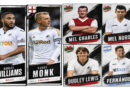
There was little doubt about the first name selected in defence. Ashley Williams finished comfortably top of the poll and appeared in almost every voter’s top two. The former captain’s place in Swansea folklore was already secure, but the result confirmed just how highly he is regarded by supporters across generations.
Joining him at centre-half was Mel Nurse. While many younger supporters may never have had the opportunity to see him play, the Swansea legend’s reputation clearly endures. A one-club man who made over 500 appearances for the Swans and captained the side during one of the most successful periods in the club’s history, Nurse’s place alongside Williams feels thoroughly deserved.
Now attention turns to midfield.
We are building our side in a traditional Swansea 4-2-3-1 formation, featuring a lone striker, a creative No.10 operating behind him and two wingers providing the attacking threat from wide areas. This week’s vote focuses on the two central midfield positions – the engine room of the team.
These are the players tasked with winning the ball, keeping possession, controlling the tempo and making Swansea tick. From the First Division heroes of the early 1980s to the stars of the Premier League era, Swansea have been blessed with some outstanding midfielders.
Here are the seven contenders for the two central midfield places.
John Mahoney
John Mahoney gives this shortlist a vital link to Swansea City’s famous First Division side under John Toshack. A Welsh international midfielder, Mahoney had already enjoyed a distinguished career with Stoke City and Middlesbrough before arriving at the Vetch Field in 1979. He brought experience, intelligence and composure to a Swansea team making one of the most remarkable climbs in British football.
Mahoney was very much a proper central midfielder, often operating in a deeper role where he could win the ball, keep play moving and bring others into the game. Swansea City list him as making 139 appearances and scoring six goals for the club between 1979 and 1983. He was part of the side promoted to the First Division in 1981 and remained involved during the club’s top-flight years. He may not be the most glamorous name on the list, but for representing that golden early-80s era, he is a very strong candidate.
John Cornforth
John Cornforth belongs to a different Swansea era entirely – a key midfielder of the early-to-mid 1990s. After joining Swansea from Sunderland in 1991, Cornforth became an important figure at the Vetch Field and was part of the side that won the 1994 Football League Trophy at Wembley.
That Wembley final remains one of the great days in Swansea’s pre-modern history, with the Swans beating Huddersfield Town on penalties after a 1-1 draw. Cornforth scored Swansea’s goal, was named man of the match, and later spoke proudly about that team sometimes being the “forgotten team.” He made 149 league appearances for Swansea, scoring 16 goals, and also won two caps for Wales. A proper midfielder with quality and character, Cornforth deserves his place as the representative of that 1990s Vetch Field generation – a time when fans and players felt closer.
Matt Grimes
Few Swansea players have divided opinion quite as much as Matt Grimes. Yet when the statistics are examined, his contribution to the club is difficult to ignore.
Since joining Swansea in 2015, Grimes has become one of the club’s longest-serving players and has captained the side through some challenging years following relegation from the Premier League. Calm on the ball and capable of controlling possession from deep areas, he has been the focal point of Swansea’s midfield for much of the past decade.
Grimes ranks among the club’s highest appearance makers and has consistently been one of the Championship’s most productive midfielders in terms of passing and chance creation. While supporters may debate his style of play, few would question his commitment or consistency.
Longevity alone does not guarantee greatness, but Grimes’ influence over such a prolonged period means he deserves serious consideration alongside some of the finest midfielders Swansea City have produced.
Leon Britton
Few players have become as closely associated with Swansea City as Leon Britton. Signed by Brian Flynn in 2002, Britton would go on to become one of the most influential figures in the club’s history, helping the Swans rise from the bottom tier of English football to the Premier League.
While he was never the tallest, quickest or strongest player on the pitch, Britton possessed an extraordinary football brain. His ability to receive the ball under pressure, retain possession and dictate the pace of a game made him the heartbeat of Swansea’s possession-based style. Under Roberto Martínez, Paulo Sousa and Brendan Rodgers, he became the perfect symbol of how Swansea wanted to play.
Britton made more than 500 appearances for the club across two spells and remains one of the most respected figures in Swansea’s history. For many supporters, he is the first name that comes to mind when discussing Swansea’s greatest-ever midfielders.
Joe Allen
Nicknamed the “Welsh Xavi” during his rise through Swansea’s academy, Joe Allen was another player perfectly suited to the club’s passing philosophy. Calm, intelligent and technically gifted, Allen developed into one of the finest midfielders produced by Swansea’s youth system.
After helping Swansea win promotion to the Premier League in 2011, Allen established himself as one of the league’s most accomplished midfielders. His performances earned a move to Liverpool, where he worked once again under Brendan Rodgers, before later returning to Swansea in 2022.
Although his first spell at the club was relatively short compared to some others on this list, Allen’s quality was never in doubt. Few players have combined technical ability, work rate and tactical awareness quite as effectively. His influence on Swansea’s most successful modern side ensures his place among the club’s midfield greats.
Ferrie Bodde
Had injuries not intervened, Ferrie Bodde may have gone down as one of the greatest players ever to wear a Swansea shirt.
The Dutch midfielder arrived from ADO Den Haag in 2007 and quickly became a fan favourite. Powerful, creative and blessed with a superb range of passing, Bodde could do almost everything. He could score spectacular goals, win tackles, dominate midfield battles and unlock defences with a single pass.
His performances during Swansea’s League One title-winning campaign of 2007-08 were exceptional, earning widespread praise and attracting interest from higher-level clubs. Tragically, a serious knee injury suffered in December 2008 effectively ended his career at the highest level.
Despite spending only a relatively short period at the club, Bodde’s impact was immense. Even today, many supporters still wonder what might have been had injury not cut short the career of one of Swansea’s most talented midfielders.
Tommy Hutchison
One of the most experienced players ever to represent Swansea City, Tommy Hutchison arrived at the Vetch Field in 1981 and immediately became a key figure in John Toshack’s side.
Already a respected international with Scotland and a veteran of top-flight football, Hutchison brought leadership, composure and quality to a Swansea team embarking on its first-ever season in the First Division. As captain, he helped guide the Swans through one of the most remarkable periods in the club’s history.
A clever and technically gifted midfielder, Hutchison contributed both goals and assists while providing invaluable experience alongside younger teammates. His professionalism and influence on and off the pitch made him one of the leaders of Swansea’s greatest-ever side.
Although he spent only a few years at the club, his role in establishing Swansea among the elite of English football ensures he remains a legendary figure in the club’s history.