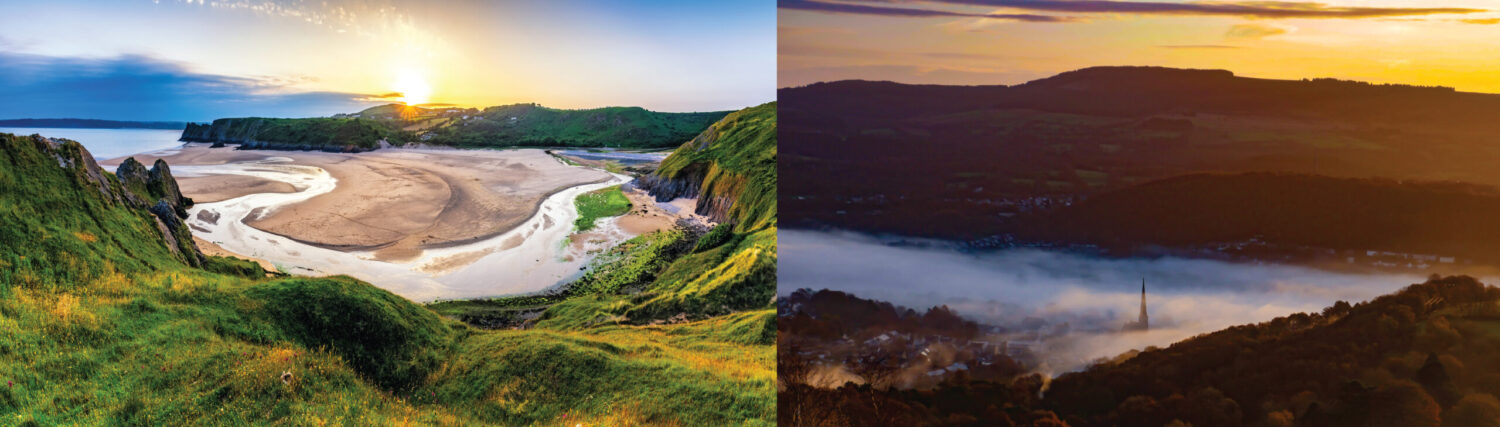

Dark Skies Over Ystalyfera – A stargazing primer for October 2025
October brings with it earlier night skies. The Brecon Beacons has proudly boasted having International Dark Sky Reserve status since 2013 but we don’t need to travel to enjoy a start spectacular.
Cwmllynfell and the hills above Ystalyfera sit just high enough to escape most village glow and give a big, open horizon. On the right nights this October you can catch the Milky Way, bright Saturn, a pre-dawn Jupiter, and two reliable meteor showers.
This autumn and winter we are launching a simple night-sky guide. Each month we will flag the best nights to get outside, what to look for, and how to see it with the least fuss. For this first instalment we start with a quick, plain-English explainer of common sky terms, then dive into October’s highlights.
Quick sky terms in plain English
Opposition – A planet is at opposition when Earth is between it and the Sun. The planet rises around sunset, sets around sunrise, and looks biggest and brightest for the year. Think of opposition as that planet’s prime time.
Conjunction – Two objects appear close together in the sky. They are not necessarily close in space, they simply line up from our viewpoint.
Elongation – How far an inner planet like Mercury or Venus appears from the Sun in the sky. A large elongation makes that planet easier to spot after sunset or before sunrise.
New Moon, First Quarter, Full Moon, Third Quarter
New Moon means the Moon is near the Sun and its night side faces us, so the sky is darkest. First Quarter is the bright half-moon in the evening. Full Moon brightens the whole sky and hides faint stars. Third Quarter is the half-moon in the early morning.
Seeing and transparency – Seeing is how steady the air is. Good seeing gives sharper planets. Transparency is how clear the air is. Good transparency reveals more faint stars and the Milky Way. For wide views, transparency matters most.
Averted vision – Look a little to the side of a faint object rather than straight at it. The edge of your vision is more sensitive in low light, so the Milky Way and the Andromeda Galaxy stand out more easily.
Dark adaptation – Your eyes take 15 to 20 minutes to adjust to darkness. Avoid bright screens and white torches. Use a red light if you can.
Best dark windows
The Moon is your built-in light switch. Early October is bright, then it fades.
• Full Moon Tuesday 7 October, bright skies for a few days either side.
• Third Quarter Monday 13 October.
• New Moon Tuesday 21 October, this is your prime dark week.
• First Quarter Wednesday 29 October.
For Milky Way views, aim for the period 16th to 24th October, with the darkest nights centred on 19th to 23rd October.
Planets to spot
• Saturn is excellent all month. It reached opposition in late September, so it remains bright in the evening sky from the southeast to the south. A small telescope shows the rings. Binoculars reveal a small golden disc and sometimes a nearby moon.
• Jupiter is a bright pre-dawn object that climbs higher as the month goes on. It will not reach opposition until early 2026, yet it is already eye-catching before sunrise.
• Venus is a morning planet in early October and gets harder to see toward month end. Look low in the east before sunrise during the first half of the month.
• Mercury and Mars sit very low at dusk around the third week of October. Around 19th to 20th October Mercury passes close to a faint Mars near the western horizon just after sunset. This is a challenge.
• Uranus and Neptune need binoculars or a small telescope and darker skies. Uranus improves toward its November opposition. Neptune is very faint but technically in season.
Meteors in October
• Draconids peak around 8th to 9th October. Best seen in the evening, although a bright waning Moon will reduce numbers this year. Block the Moon with a hedge or hill and face north to northwest.
• Orionids peak around 22nd to 23rd October with roughly 15 to 20 meteors per hour in good conditions. The Moon will be only a thin sliver, so this is the month’s best meteor watch. After midnight, face southeast toward Orion.
Where to stand
• The open ground on Alltygrug above Ystalyfera gives wide views once you are away from houses and the A4067.
• The lanes that climb toward Mynydd y Gwrhyd from Cwmllynfell have small pull-ins with big southern and eastern horizons. Keep fully off the tarmac, leave space for passing traffic, and avoid blind summits or farm gateways.
• If you prefer to stay near the villages, a dark corner of a playing field or a quiet riverside path can be enough once the street lights are behind you.
Keep lights low. Switch headlamps to red if you can. Let your eyes adapt before judging the sky.
Simple kit and phone tips
You do not need a telescope.
• Binoculars in the 8×40 or 10×50 range are perfect. They turn faint smudges into star fields and make Andromeda obvious.
• Warm layers are essential on the ridge. Add hat, gloves, and a windproof layer.
• A chair or mat keeps you comfortable and off damp ground.
• A flask helps you stay out longer.
Phone photos are possible.
Stabilise the phone on a mini-tripod, fencepost or car roof.
Use Night or Pro mode and try 10 to 20 second exposures.
Tap a bright star to focus or set manual focus to infinity.
Use a timer to avoid shake.
Take several frames and stack in-phone if your model supports it.
Safety, wildlife and good manners
These are working landscapes with rough ground. Carry a torch with a red mode, watch for holes, keep dogs on leads near livestock, avoid flash photography, close gates, take litter home, and keep noise down for other stargazers and for bats.________________________________________
Next month
We will switch from terms to targets and pick the best nights for November, including planets, the Leonids, and a simple binocular tour you can do from the same ridge. If you capture a good photo this month, send it in and we will print a few reader shots in the feature – info@southwalesmedia.com